Welcome to my Art Style Studies. This gallery contains conceptual conceptual art I had created as exercises and art studies to keep my artistic thumbprint flexible for whatever aesthetics and designs any future projects may have! With each section, there will be a small blurb about the media/artist the studies are based on.
Click ☰ to go back to the Gallery Directory!

"The Amazing Digital Circus" is an indie phycological dark comedy based on the 1967 horror short story "I Have No Mouth and I Must Scream" by Harlan Ellison under the studio GLITCH Productions, created by the artist, director and composer/songwriter Cooper Smooth Goodwin (known online/primarily as Gooseworx).
The series follows a human woman who finds herself trapped with five other humans in a 90s edutainment nightmare run by the rogue AI, Caine, who is desperate to please the trapped humans with his increasingly nightmarish adventures.
The mini series acts primarily as a character analysis, taking time for each episode(s) to examine why the characters behave the way they do, and the human experience that comes with it. Including in these character analysis are the designs themselves, a.k.a the avatars the Digital Circus provides per each human. Because the choice of the avatar is not insertional on the character's behalf, it tends to say a lot about what is going on in their minds, their primary traits as people, and especially reflect the traits that they themselves may not be too fond of.
Combine that with a 90s computer aesthetic, and it makes thinking on character design a particular challenge that requires intention, and reflecting visually what is going on with said characters. It created a challenge of balancing both the simple aesthetics of the limited graphics 90s animation/modeling softwares were capable of, while acknowledging the outrageous and loudness the era had visually.


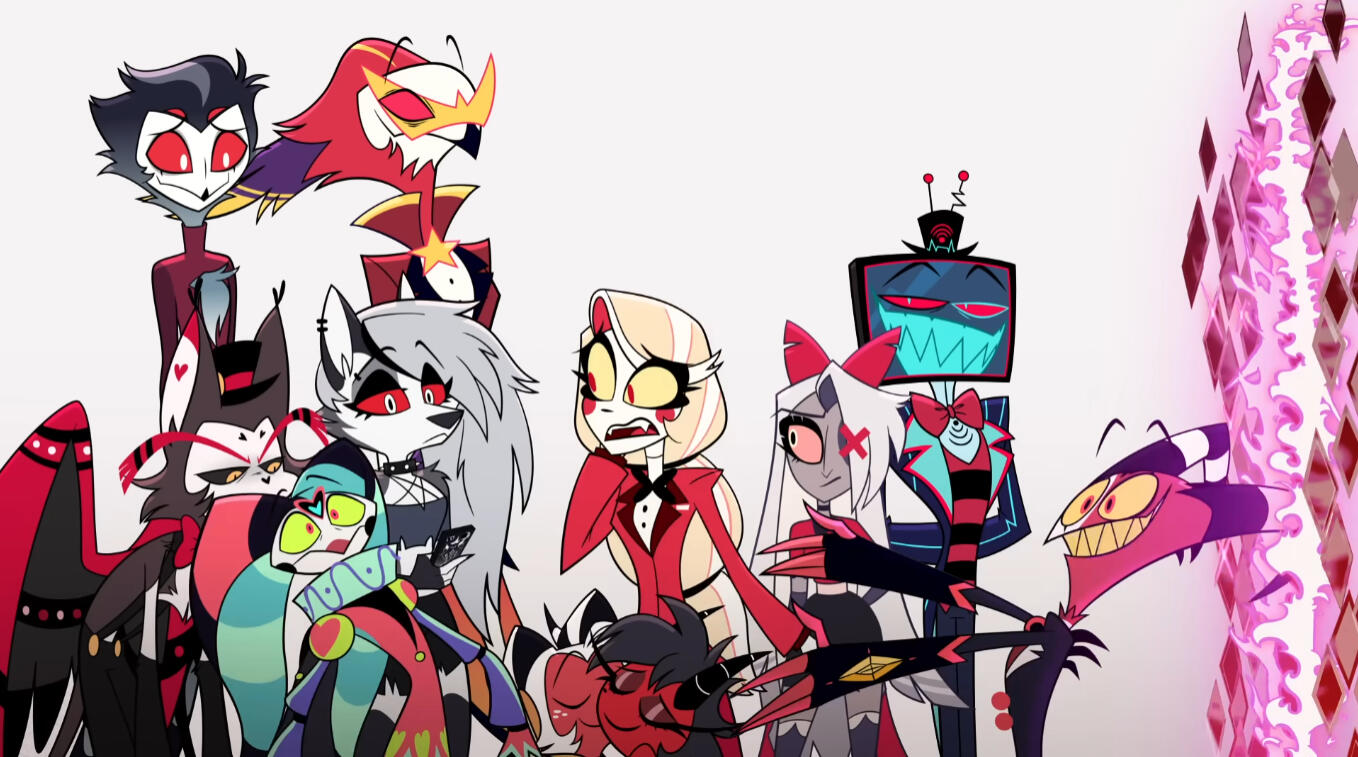
Amazon Prime's "Helluva Boss" and "Hazbin Hotel" are two dramedy action series set in the same Musical Hellish world created by Vivian Medrano (known online as Vivziepop). "Hazbin Hotel" follows the desperate path of Lucifer's daughter, Charlie Morningstar, to prove that there is no such thing as eternal damnation, and that even the worst of the worst among the mortal souls her father rules over can be redeemed. "Helluva Boss" acts as a lens to see what this world is like for the "everyman" denizens of Hell, by following the chaotic life of an imp named Blizø (the "o" is silent) who is desperate to not only make a name for himself and employees, but prove that imps can be more than lower-class citizens.
Vivian Medrano's art is known for utilizing the lankiness of her characters to a visual and animation advantage, and is in a constant balancing-act of overbearing visuals while still keeping appeal and consistency. In these shows, the storytelling of the character interestingly comes down not necessarily an individual-basis, but rather how all the characters in a lineup relate to one another; which does tie in for both of the shows' heavy themes relating to relationships of every kind; familial, romantic, antagonistic, unhealthy, balanced; if you name a dynamic, it is likely that either show (or both!) have explored it.
Because of this, many of the character design sheets for the studies required a lot of note-taking in both keeping up with visual character traits to emphasize genetics, but also keeping up with the consistency in uses of colors, or being aware of said rules to know when they should be broken to create a visual implication.


This next style study was an attempt to combine the two distinct art styles of the Disney XD Limited Series "TRON: Uprising" and League of Legends' "Arcane".
"TRON: Uprising" acts as a sequel to the 1982 film "TRON", and a prequel to 2009's "TRON: Legacy", taking place during a time of disruption and rebellion, as the citizens of the city Argon attempt to take back their freedom...and how those attempts eventually fail.
"Arcane" is a series that acts somewhat of an anthology, adapting the lore behind each characters from the game franchise "League of Legends", tying the web of plots into a singular line.
Both art styles thrive on approaching realism before pushing the exaggerations to the extremes. In the animation for both series, there is a unique attention to detail in body language, and especially in characters' expressions. However, their visuals could be considered opposites in their handling of coloring said characters.
The art direction of "TRON: Uprising" was headed by famous artist Robert Valley, who is known for his minimal use in colors on characters for the sake of emphasis and pop, while keeping the shading a stark black. "Arcane" was animated and produced by the famous French studio "Fortiche", known for their painterly art styles and textures. However, they both share bold and cinematic lighting that ties their looks together well. Combining these distinct opposites ended up creating a visually appealing aesthetic that while challenging was very much worth the visual reward.
Below is a collection of recolored/redrawn screenshots for texturing tests, complete screencap redraws, and finally a complete illustration created from scratch with all that was learned over the time of doing this style study.


